Because Kowloon is going to be the environment that the player is going to interact with, we focused all of our lighting study efforts on different areas of the city that the player might explore.
We've decided that the overall lighting of the city is going to be a sickly green, representative of how it's been corrupted by the rogue channeler's influence over the jiangshi. To offset that, we've been using orange and yellow lights primarily, so it doesn't look too Christmas-y, though we did throw in a few red lights for accent as well.
The alleyway has minimal lighting, as it's out of the way of the main streets. There could be some lanterns, however, strung across the narrow walkway.
To give Kowloon a modern flair on top of its more mixed architecture, we added neon light elements as well as the lanterns and other lights. These areas are significantly more well-lit, as they are the main thoroughfares for the city.
For the Warehouse, we worked with getting a more dim, tense lighting.
We referenced old warehouse spotlight lamps, where the scene is populated by cone spotlights with areas of ambiguous darkness. As the Boss, Shanzhu, stalks after you through the scene, the lighting and shadows about him will change dramatically, whether he gets sharp back-lighting, ominous overhead lighting, or head-on lighting.
For our initial animation considerations and pose studies, we chose our most intimidating antagonist, Shanzhu the jiangshi, as our subject. The main reason for this being is that he is the focal point of our boss battle, and getting his intimidating presence and movements down is going to be crucial to maintaining tension in that selfsame battle.
As stated below, we've looked into several Disney villains, such as Ratcliffe from Pocahontas and Sykes from Oliver & Company, not only for general body type but also the way that they move. In our poses, we wanted to nail the ease and confidence that Shanzhu has in himself and how that can intimidate and overpower the player.
In these poses, we wanted to show Shanzhu's size and stature and how that relates to his overall demeanor: he is very commanding and has a leonine sort of ease and confidence to his movements (despite his massive size). Maintaining his cool is very important to him, except it doesn't always work...
When the player manages to strike him, he loses that composure. The boss battle revolves around attacking his talismans, and Shanzhu has a personal fear of people seeing his face. When struck, he instinctually acts to hide his face from the player.
A main phase of the boss battle is where Shanzhu reaches out to the player to grab them. We wanted to show that and also how intimidating it could be in action.
(Poses were courtesy of Alex Papanicolaou, KC Brady, and Claire Rice, while Summan Mirza provided the rig.)
As mentioned, we started researching videos to provide some inspiration and goal for how each character will move. Because the game is heavily stylized with our Sam Nielson artist inspiration, we tried to stay within the general realm of Disney. It's not to say all of them are, of course, but it was the first place we went when considering.
For Shanzhu, we looked at Ratcliffe from Pocahontas and Sykes from Oliver & Company.
(1:32)
We also started to consider inspirations for other characters, such as...
Pitch Black from Rise of the Guardians for the demeanor/movement of the rogue channeler. Though Pitch is much more talkative and charismatic than the enigmatic type of personality we're going for the rogue channeler, the overall ethereal manner of his movements and the way he disappears into shadows is important to emulate.
Jim Hawkins from Treasure Planet for Chao. We especially liked the rounded manner of his movements and how everyday and commonplace they make him seem.
(2:35)
And the movements of the mermaids from The Little Mermaid for Shahzaad, which is very important because of his levitation and the movements of his tail.
We also did more research into blend shapes for our facial animation. Here is a blend shapes facial animation set which we are going to perhaps be using as reference for different expressions to blend to. The goal is to make a low-res base mesh which we can use to make these and then blend towards, so it doesn't end up being too taxing.
In the next week, we will be seriously delving into demoing
technical considerations for the art and style of this project, such as
particle effects, animation features, and environment modularity.
In terms of Shahzaad’s fire pieces, we decided against
creating them purely through particle effects, and continued towards Nielson’s
overall sculpted aesthetic by having the fire be modeled in mesh. To simulate the look of living fire, we explored
layering panning and rotating emissive textures in UE4’s material editor to
give a stylized appearance of fire:
We hope to refine on this stylization, and will also work on
some sort of physics-based joint system that will give the mesh fire pieces
more natural movement and life.
For animation, we’ve been working on refining a specialized
auto-rigger that could be used to not only quickly animate Shahzaad and his
wispy ghost tail, but perhaps other proxy spirits that may populate the Walled
City:
The auto-rigger will have IK/FK switching capability, as
well as specialized controls such as IK splines and driven keys to easily
animate motions of the wispy tail, such as the tail curling or undulating.
As for facial animation, we are currently exploring the
option of using blendshape-based animation.
As blendshape states in UE4 are accessible as attributes, we find that
this would best suit the Character Interaction portion of our game. When the player meets Chao and speaks to him,
the screen becomes fixed and Chao will physically react/change when the eye
passes over certain collision boxes over points of interest. Linking such eye-triggered events with a
subtle change in blendshape state as he speaks would be preferable to having
extensive management of joint-based animation to blend different mood states
with speaking states and so forth.
For environments this week, striving to unify style was the primary goal this week. We did a workshop on composition and value when it came to 2D art pieces, which I believe helped a lot in the composition of these.
For this last piece, we simulated the HUD of the game. The UI is extremely minimalist in our game: the reticle on the door represents both the player's health and their companions' cooldowns.
We also continued to use modular studies. These were very important less for color and value and more for the shape language—the environment artists consolidated these designs before they started their compositions so they could repeat them throughout the design process. This would allow them to already begin to think about how modular pieces might be used in the game engine to create the environments. It was also important to study how edges world work in the environment. Curves and angles were used much the same that they were used for the characters' designs. They also created a stylized look for these objects: they have borders or double lines for edges.
UPDATE: Based on teacher feedback, we were asked for more mockups to see how characters would exist in the environment. We worked together to try to show a 2D representation of how we hope it will look in engine. We also added some written characteristics, having decided what sort of language we're going to use for the world itself.
After consolidating the feedback we were given last week on our character designs, the art team pooled together to decide what the finalized designs would be. After we decided on the proportions and shape language, we also decided on color palettes for each individual character. We decided that the torso of each character was the most important structural element, so we made the proportions slightly different that the top half would be roughly 2/3rds of the design and the legs would be 1/3rd of the overall height.
When it came to rendering, maintaining a link back to our Sam Nielson inspiration was important. We used a tutorial he gave on his shading style to focus onto that look.
We have also made some rough guidelines of how tall each character will be in relation to one another.
Continuing to take strides to unify the art style of our game was of utmost importance this week. We met and discussed our shape language and how it affected both characters and environment aspects, and we continued to check in with our various team members multiple times throughout the week to discuss ways to maintain contact and try to keep all of our art on relatively the same plane.
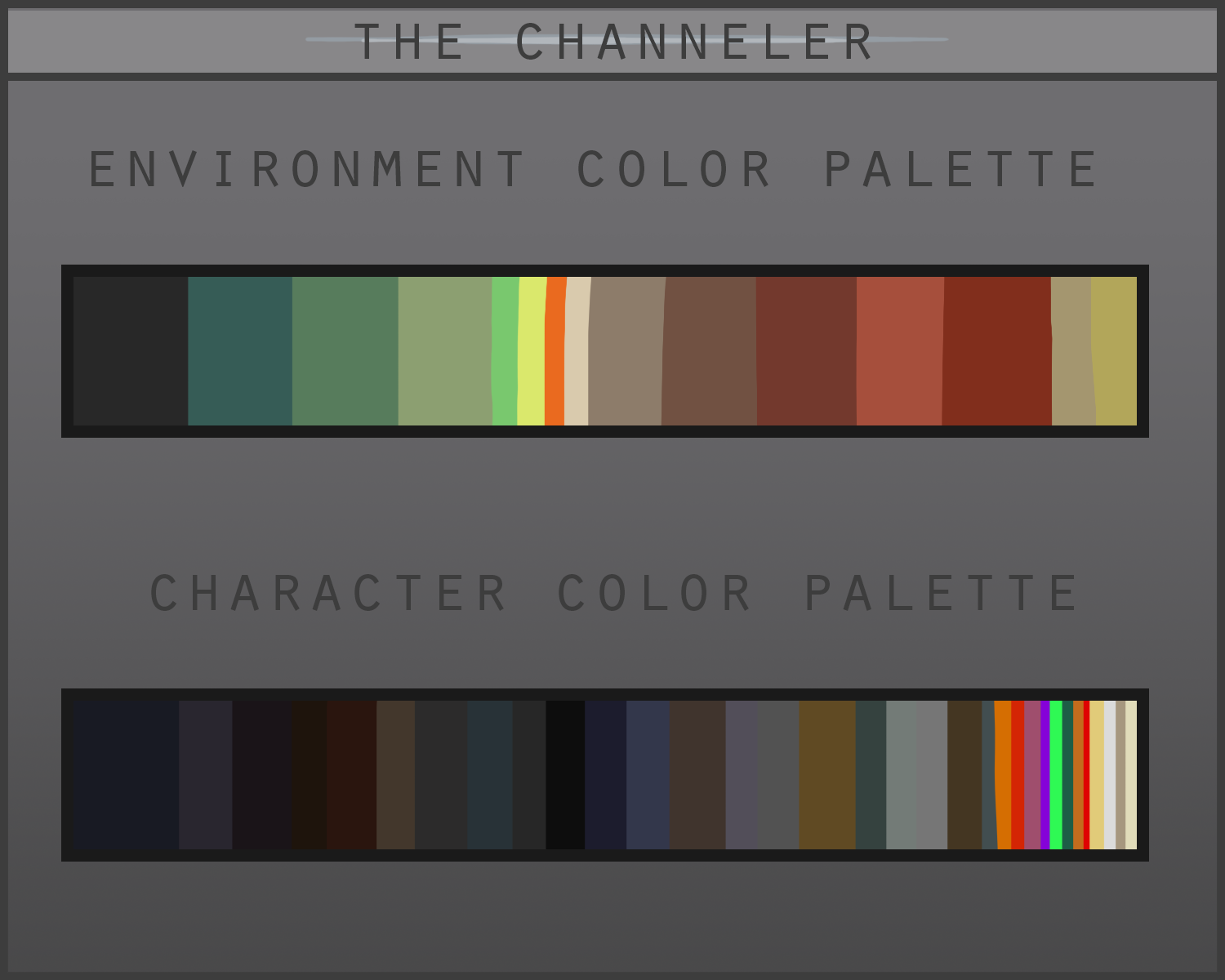
Color was also very important this week. We determined color palettes for each environment and each character. These will be displayed alongside their respective character or environment later in this presentation, but we created an overall color palette to guide the aesthetic of our game.
Our environments use colors which are largely midtone in value, with some much more saturated and bright colors as accents. Characters are similar, though their desaturated base tones can have much deeper values (to make them stand out of environments). They also use very bright, very saturated colors as accents to draw the eye.
The environments of the game were altered slightly, in both scope and overall lore and presentation.
The scope of the CSA will be scaled back so that design focus can be put on the Walled City. Though we still developed the overall look of the interior, its inclusion in the game will be either linked to an intro sequence or a very small slice of the area.
Also, Kowloon was renamed to the Walled City, so that it can be a more multicultural area than strictly of Asian aesthetic influence. Though the design of the area will be based on real-world Kowloon, lore-wise in the game it will be seen as a sort of Hong Kong of the spirit world. It's a place where tons of spirits—many of which did not go through the proper channels at the CSA—take up residence in the world.
This week the entire team worked towards matching a a single style. This was done in both the shape language, color use, and the overall ambiance of the art.
Modular designs were also worked on to give us ideas on how to implement these ideas into the game environment. Because the Walled City in particular will be extremely crowded, it will be extremely important to be industrious with our modularity so we can save time in crafting the game environment.
Technical Concerns: The major technical concerns for environment in particular are making sure that the particle systems used in the game (smoke, fire, sparks, etc.) match the overall art style.
Because of the sculpted style we are going for, the default effects in UE4 will not be adequate. We will look into making our own particle systems that generate the look that we are going for.